![Free Printable Editable Bill of Sale Form Template [PDF, WORD]](https://billofsale.authorizationletter.org/wp-content/uploads/2026/06/billofsale_logo-206x48.png)
Keeping detailed records is a smart way to protect both buyers and sellers during a transaction. A Maryland Bill of Sale documents important information about a sale, including the parties involved, the property description, and the agreed purchase price. This form helps establish proof of ownership transfer and can be useful when meeting registration or administrative requirements. A well-prepared sales record also helps reduce disputes and ensures that the terms of the transaction are clearly documented.
Download Free Printable Maryland Bill of Sale Template
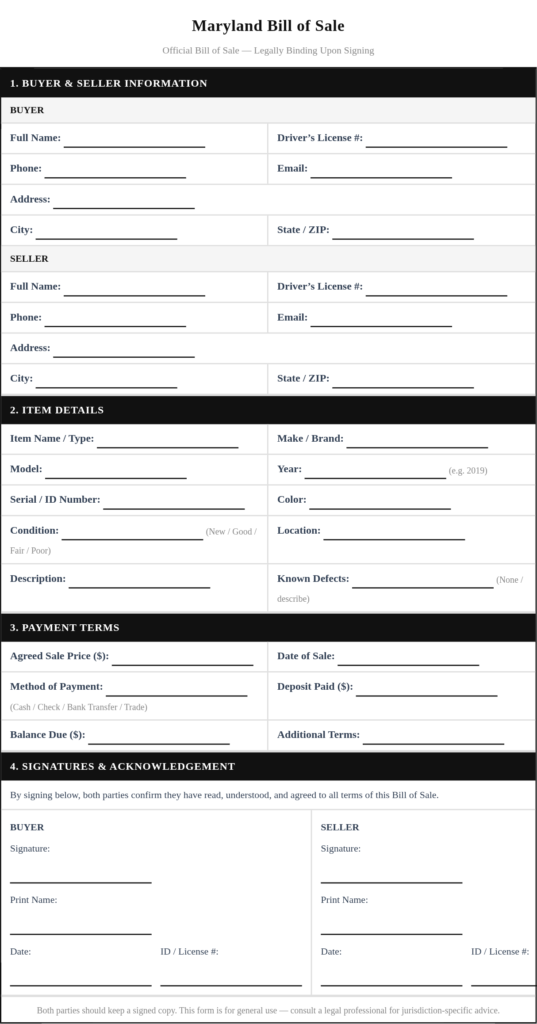 What Is a Maryland Bill of Sale?
A Maryland Bill of Sale is a legal document that records the transfer of ownership for personal property between a buyer and a seller. This signed copy serves as proof of purchase and protects both parties by documenting the sale price, item details, and the terms of the private sale. While Maryland does not require a bill of sale form for all transactions, many buyers and sellers use this purchase record for vehicles, boats, electronics, and other valuable items to create a legally binding sale agreement and ensure a clear property transfer.
Documents required in Maryland Bill of Sale
- Government-Issued Identification
- Buyer and Seller Information
- Property Description and Sale Details
- Proof of Ownership Documentation
- Completed Bill of Sale Form
Information Included in a Maryland Sale Agreement
- Buyer's Full Name and Address
- Seller's Full Name and Address
- Property Description and Condition
- Sale Price
- Date and Signatures.
How to Complete a Maryland Bill of Sale Form
- Identify the item being sold and write a detailed description including make, model, serial number, VIN, or other identifying features. Include the condition of the property to avoid disputes later.
- Write the full legal names and current addresses of both the buyer and the seller. Make sure all contact information is accurate and complete.
- Enter the sale price in both numbers and words to prevent confusion or alterations. Specify the payment method and whether the buyer has paid in full.
- State the date of the sale and the location where the transaction takes place. This creates a clear timeline for the transfer of ownership.
- Include an as-is clause if the seller offers no warranty or guarantee on the item. This protects the seller from future claims about the condition of the personal property.
- Have both the buyer and seller sign and date the bill of sale form in ink. Each party should initial any corrections made to the document.
- Make copies of the completed purchase agreement for both parties. Keep your signed copy in a safe place as a permanent purchase record.
How to Notarize a MD Bill of Sale
- Understand that Maryland does not require notarization for most bills of sale, but getting a notarized document adds legal weight and prevents fraud. Notarization is optional for vehicles, boats, and personal property in Maryland.
- Bring a valid government-issued photo ID such as a driver's license or passport to prove your identity to the notary public. Both the buyer and seller should appear in person if both signatures need notarization.
- Sign the bill of sale form in front of the notary public, not before you arrive. The notary must witness you signing the legal document to validate it properly.
- Pay the notary fee, which typically ranges from five to fifteen dollars in Maryland. Some banks offer free notary services to account holders.
- Receive the notarized document with the notary's official seal and signature. This creates a legally binding record that courts and agencies recognize more readily than unsigned documents.
FAQs
Q. Is a bill of sale legally binding in Maryland without notarization?
Yes, a bill of sale form is legally binding in Maryland even without notarization as long as both parties sign it. The signed copy proves the transfer of ownership and the agreed sale price. Notarization simply adds an extra layer of authenticity but is not required for the purchase agreement to be valid.
Q. Do I need to notarize a Maryland bill of sale for a vehicle?
Maryland does not require you to notarize a bill of sale for vehicle transactions. However, the Maryland Motor Vehicle Administration requires you to complete the title transfer properly when you sell or buy a car. A notarized document can help prevent disputes about the sale agreement, but Maryland sale requirements do not mandate it for private sales.
Q. Should both the buyer and seller keep a copy of the bill of sale?
Yes, both the buyer and the seller should keep a signed copy of the bill of sale as a permanent purchase record. This legal document protects both parties if questions arise later about the sale price or the condition of the item. Store your copy in a safe place with other important paperwork related to the property transfer.
Q. What information must a Maryland bill of sale include to be valid?
A valid bill of sale form must include the names and addresses of the buyer and seller, a detailed description of the personal property, the sale price, and the date of sale. Both parties must sign the purchase agreement to make it legally binding. Adding a statement about the item's condition and whether any warranties apply helps create a complete sale agreement.
Q. Can I use a bill of sale for any type of property in Maryland?
You can use a bill of sale form to document the sale of almost any personal property including vehicles, boats, trailers, electronics, furniture, and livestock. Real estate transactions require different legal documents and cannot use a simple purchase record. The bill of sale works best for private sales of movable items where you want clear proof of the transfer of ownership.
Conclusion
Creating a Maryland Bill of Sale protects both buyers and sellers during private transactions by documenting the terms of the sale and proving the transfer of ownership. This legal document serves as your permanent purchase record and can resolve disputes about the sale price or condition of the item. Although Maryland does not require notarization for most sales, taking time to complete a thorough bill of sale form helps ensure a smooth property transfer.
Whether you sell a car, boat, electronics, or other personal property, a well-written purchase agreement creates peace of mind for everyone involved. Keep your signed copy in a safe location along with receipts, titles, and other paperwork related to the sale. A complete bill of sale demonstrates that you followed Maryland sale requirements and conducted your transaction properly. This simple step makes the entire sale process clearer and more secure for both parties.