![Free Printable Editable Bill of Sale Form Template [PDF, WORD]](https://billofsale.authorizationletter.org/wp-content/uploads/2026/06/billofsale_logo-206x48.png)
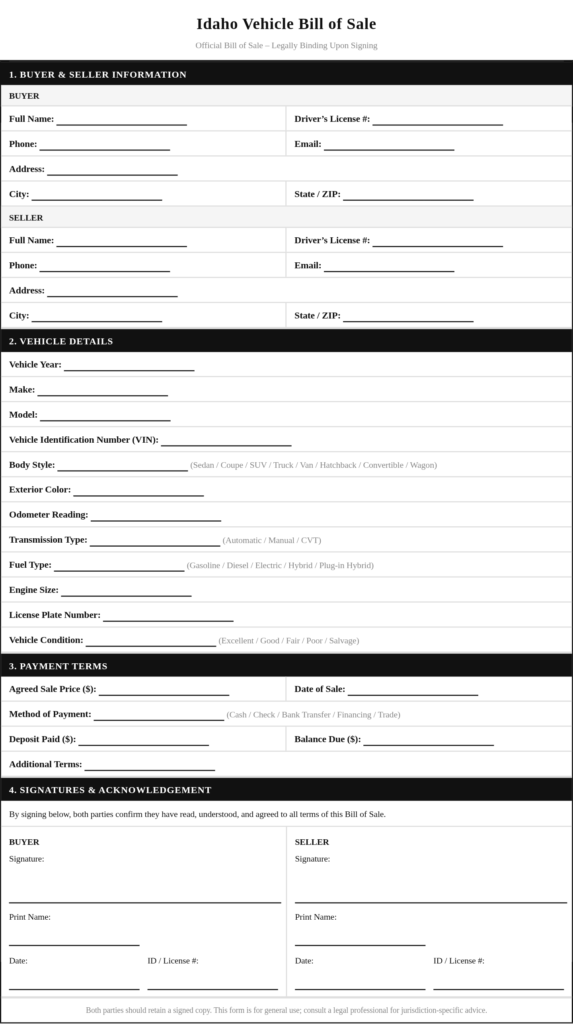
A Idaho Vehicle Bill of Sale is a legal document that records the transfer of ownership when you buy or sell a car, truck, motorcycle, or other motorized vehicle in Idaho. This purchase agreement serves as an official record of the transaction, capturing important details like the sale price, vehicle identification number (VIN), odometer reading, and the names of both the buyer and seller. It protects both parties and provides proof that the vehicle legally changed hands.
While Idaho law doesn’t always require a bill of sale form for every vehicle transaction, having this signed document is highly recommended. The Idaho Transportation Department (ITD) may request a bill of sale during the registration process, especially for older vehicles or when applying for a title. This purchase record also helps establish the sale price for tax purposes and protects sellers from future liability once the vehicle leaves their possession.
Free Printable Idaho Vehicle Bill of Sale Template [Editable]
Benefits of Idaho Vehicle Sale Agreement
- Provides legal protection for Idaho sellers by documenting the exact date and terms of the sale, which helps shield you from parking tickets, accidents, or other liabilities after the vehicle changes hands
- Helps Idaho buyers prove legitimate ownership when registering the vehicle with the Idaho Transportation Department, especially for vehicles without a clear title history
- Documents the agreed-upon sale price, which is essential for calculating the correct Idaho sales tax owed during the registration and titling process
- Creates a detailed purchase record that includes the vehicle's condition and odometer reading, offering protection against odometer fraud under Idaho and federal disclosure requirements
- Serves as proof of an as-is sale when applicable, clearly stating that the buyer accepts the vehicle in its current condition without warranties from the seller
- Establishes a paper trail that Idaho courts recognize as valid evidence if any disputes arise between the buyer and seller after the transaction is complete
What type of Vehicle can it be used for?
In Idaho, a vehicle bill of sale can be used for the transfer of any motorized vehicle, including passenger cars, pickup trucks, SUVs, motorcycles, ATVs, boats with motors, trailers, RVs, campers, and snowmobiles. Whether you're buying or selling a brand-new vehicle or a used one from a private party, this sale agreement documents the transaction. The form works for both titled and non-titled vehicles, though Idaho requires titles for most motor vehicles manufactured after certain years.
Mistakes you should avoid while signing a Idaho Vehicle Bill of Sale
- Forgetting to include the complete vehicle identification number (VIN), which Idaho's Transportation Department needs to properly register and title the vehicle
- Leaving the odometer reading blank or recording it incorrectly, as federal and Idaho law requires accurate mileage disclosure for most vehicle sales
- Not getting signatures from both the buyer and seller, making the document incomplete and potentially invalid as proof of the transaction
- Failing to keep multiple signed copies of the bill of sale, leaving one or both parties without documentation for DMV registration or future reference
- Writing vague descriptions of the vehicle's condition or leaving out important details about known defects, which can lead to disputes after the sale
- Not dating the document properly or using an incorrect date, which can cause confusion during the Idaho title transfer and registration process
Required Documents for Idaho Vehicle Sale Agreement
- The original Idaho vehicle title signed by the seller (or a lien release if there's an outstanding loan on the vehicle)
- A completed Idaho Vehicle Bill of Sale with signatures from both buyer and seller, including the sale date and purchase price
- Valid photo identification for both parties, such as an Idaho driver's license or state-issued ID card
- Odometer Disclosure Statement if the vehicle is less than ten years old, which can be included on the title or bill of sale form
- Vehicle history report or inspection records (recommended but not always required) to verify the condition and background of the vehicle
- Proof of Idaho vehicle insurance in the buyer's name before registering the vehicle with the Idaho Transportation Department
Frequently Asked Questions
Does Idaho require a bill of sale to transfer a vehicle?
Idaho doesn't legally require a bill of sale for all vehicle transfers, but the Idaho Transportation Department strongly recommends having one. It serves as proof of the transaction and can be requested during the title and registration process, especially if there are questions about the sale price or ownership history.
Does a vehicle bill of sale need to be notarized in Idaho?
No, Idaho does not require a vehicle bill of sale to be notarized. However, both the buyer and seller must sign the document to make it valid. Some people choose to have it notarized for extra legal protection, but it's not mandatory under Idaho law.
How do I register a vehicle with a bill of sale in Idaho?
To register a vehicle in Idaho, bring your signed bill of sale, the vehicle title, proof of insurance, and valid identification to your county assessor's office. You'll complete the title transfer paperwork and pay the required registration fees and applicable sales tax based on the purchase price shown on your bill of sale.
Can I use a handwritten bill of sale in Idaho?
Yes, Idaho accepts handwritten bills of sale as long as they include all essential information like buyer and seller names, vehicle details, VIN, sale price, date, and signatures. Make sure the handwriting is legible and clear so the Idaho DMV can process your paperwork without issues.
What information must be included on an Idaho vehicle bill of sale?
An Idaho vehicle bill of sale should include the full names and addresses of both parties, a complete description of the vehicle including make, model, year, color, and VIN, the sale price, odometer reading, date of sale, and signatures from both buyer and seller. Including the vehicle's condition and any warranty information is also recommended.
Conclusion
Getting a proper bill of sale form protects everyone involved in a vehicle transaction. This legal document creates a clear purchase record and makes the title transfer process smoother when you visit the Idaho Transportation Department. Whether you're buying your first car or selling a motorcycle, taking a few minutes to complete this sale agreement can prevent headaches later.
Keep your signed copy in a safe place along with other important vehicle documents. The purchase agreement proves you legally own the vehicle and shows what you paid for tax purposes. If you're selling, this form shows the vehicle is no longer your responsibility once ownership transfers to the new owner.