![Free Printable Editable Bill of Sale Form Template [PDF, WORD]](https://billofsale.authorizationletter.org/wp-content/uploads/2026/06/billofsale_logo-206x48.png)
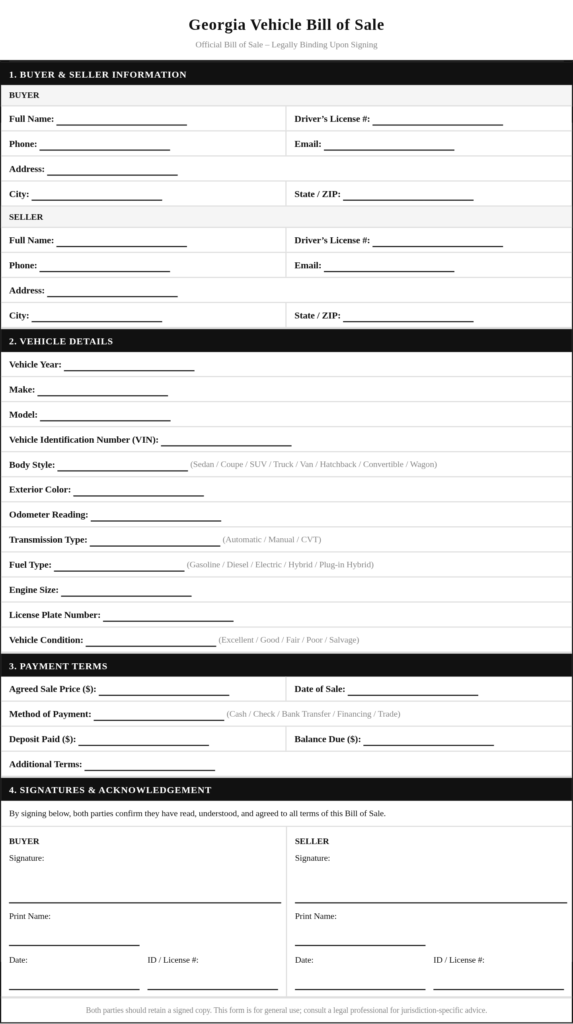
A Georgia Vehicle Bill of Sale is a legal document that records the transfer of ownership when a vehicle is sold from one party to another within the state. This essential purchase record includes important details like the buyer and seller information, vehicle identification number (VIN), sale price, odometer reading, and the date of the transaction. Having a properly completed bill of sale form protects both parties and serves as proof of purchase for Georgia DMV registration purposes.
Whether you’re buying or selling a car, truck, motorcycle, or trailer in Georgia, this sale agreement creates a clear paper trail of the transaction. The document is especially important for private sales where no dealership is involved. Georgia law recognizes this form as valid proof of ownership transfer, making it a critical piece of documentation for vehicle registration, title transfer, and tax reporting with the county tag office.
Free Printable Georgia Vehicle Bill of Sale Template [Editable]
Benefits of Georgia Vehicle Sale Agreement
- Provides legal proof of ownership transfer that Georgia county tag offices require when registering a vehicle in your name
- Protects sellers from liability by documenting the exact date and time they no longer owned the vehicle, which matters for Georgia traffic violations and accidents
- Creates an official purchase record showing the agreed-upon sale price, helping both parties with tax documentation and potential disputes
- Serves as backup documentation if the vehicle title is delayed or lost during the Georgia DMV title transfer process
- Establishes clear terms for as-is sales, which is particularly important in Georgia private party transactions where no warranty is provided
- Helps buyers prove they paid sales tax on the correct amount when registering with their local Georgia county tag office
What type of Vehicle can it be used for?
This Georgia Vehicle Bill of Sale can be used for any type of motor vehicle transaction in the state, including cars, trucks, SUVs, vans, and motorcycles. The form is also suitable for documenting the sale of trailers, recreational vehicles (RVs), boats with motors, ATVs, and other motorized vehicles. Whether you're involved in a private party sale or purchasing from a small dealership, this purchase agreement provides the legal documentation needed for ownership transfer.
Mistakes you should avoid while signing a Georgia Vehicle Bill of Sale
- Forgetting to include the complete 17-digit vehicle identification number (VIN), which Georgia requires for proper title transfer and registration
- Leaving the sale price blank or writing unclear amounts, which can cause problems with sales tax calculation at the county tag office
- Not recording the accurate odometer reading as required by Georgia law, which could result in title transfer rejection
- Failing to have both buyer and seller sign the document on the same date, creating confusion about when ownership actually transferred
- Neglecting to make copies for both parties before completing the transaction, leaving one person without proof of the sale
- Using generic online forms that don't account for Georgia-specific requirements like the need for a signed copy during tag office visits
Required Documents for Georgia Vehicle Sale Agreement
- The original Georgia vehicle title signed by the seller in the designated transfer section on the back of the certificate
- A completed Georgia Vehicle Bill of Sale form signed by both the buyer and seller with matching dates
- Valid government-issued photo identification such as a driver's license or passport for both parties involved in the sale
- Georgia Form MV-9 (Application for Certificate of Title) completed by the buyer for submission to the county tag office
- Odometer disclosure statement if the vehicle is less than 10 years old, which can be included in the bill of sale or as a separate form
- Proof of insurance in the buyer's name before the vehicle can be registered with Georgia DMV
Frequently Asked Questions
Does Georgia require a bill of sale to transfer a vehicle?
While Georgia does not legally require a bill of sale if you have the vehicle title, it is strongly recommended for all private party transactions. The document serves as critical proof of purchase for both buyer and seller, and many county tag offices request it to verify the sale price for tax purposes. Having a signed copy protects both parties in case any disputes arise.
Does a Georgia vehicle bill of sale need to be notarized?
No, Georgia does not require a vehicle bill of sale to be notarized to be legally valid. However, the vehicle title itself must be properly signed by the seller. While notarization of the bill of sale is optional, some buyers and sellers choose to have it notarized for extra security and authenticity of the legal document.
How do I register a vehicle with a Georgia bill of sale?
To register a vehicle in Georgia, take your signed bill of sale form, the properly assigned title, proof of insurance, and valid ID to your county tag office within 30 days of purchase. You'll also need to complete Form MV-9 and pay the title fee and sales tax based on the purchase price shown on your bill of sale. The county office will process your title transfer and issue a new Georgia registration.
What should the sale price show on a Georgia vehicle bill of sale?
The sale price on your Georgia bill of sale should reflect the actual amount of money exchanged for the vehicle. This purchase record is used to calculate the sales tax you'll pay at the county tag office, which is currently 7% of the purchase price in most Georgia counties. Being truthful about the sale price is important because Georgia tax officials can assess fair market value if they believe the stated amount is too low.
Can I use a Georgia bill of sale for an as-is vehicle sale?
Yes, a Georgia Vehicle Bill of Sale is commonly used to document as-is sales where the seller provides no warranty or guarantee about the vehicle's condition. The form should clearly state that the vehicle is sold as-is, meaning the buyer accepts it in its current condition with any existing problems. This protects the seller from future claims while giving the buyer a clear purchase agreement documenting the terms of the sale.
Conclusion
Completing a Georgia Vehicle Bill of Sale properly protects everyone involved in a vehicle transaction. This legal document creates a clear purchase record that helps with title transfer, registration at your county tag office, and future proof of ownership. Make sure all information is accurate and that both parties keep a signed copy for their records.
Whether you're buying your first car or selling a vehicle you've owned for years, having the right paperwork makes the process smooth and worry-free. The Georgia DMV and local tag offices rely on documents like the bill of sale form to process ownership transfers correctly. Take a few minutes to fill out this sale agreement completely, and you'll have the documentation you need for a successful transaction.