![Free Printable Editable Bill of Sale Form Template [PDF, WORD]](https://billofsale.authorizationletter.org/wp-content/uploads/2026/06/billofsale_logo-206x48.png)
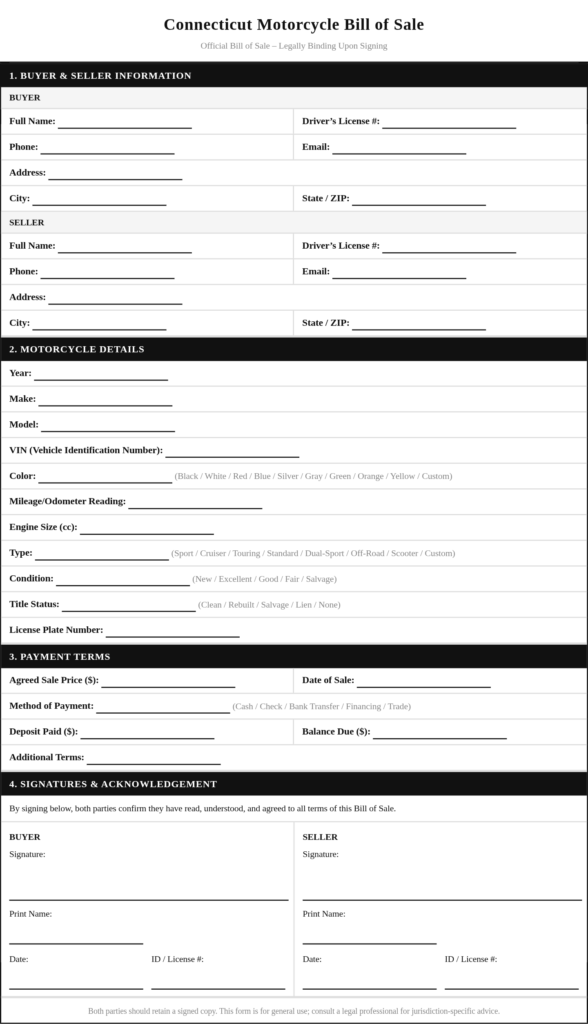
A Connecticut Motorcycle Bill of Sale is a legal document that records the transfer of ownership when buying or selling a motorcycle in the state. This simple purchase agreement captures essential details like the buyer and seller information, motorcycle description, vehicle identification number (VIN), sale price, and date of the transaction. It serves as a purchase record that protects both parties and provides proof that the sale took place.
While Connecticut does not legally require a bill of sale form for motorcycle transactions, having this signed document is incredibly useful when registering your bike with the Connecticut DMV. It acts as evidence of the sale price for tax purposes and confirms that ownership has legitimately changed hands. Whether you’re buying a vintage Harley-Davidson or a modern sport bike, a properly completed sale agreement ensures a smooth transfer process.
Free Printable Connecticut Motorcycle Bill of Sale Template [Editable]
Benefits of Connecticut Motorcycle Sale Agreement
- Provides proof of purchase price when you register your motorcycle with the Connecticut DMV, helping determine the sales tax owed
- Protects buyers by documenting the motorcycle's condition at the time of sale, especially important for as-is transactions common in private sales
- Creates a legal record that shields sellers from liability after the motorcycle changes hands, confirming they no longer own the vehicle
- Helps establish a clear chain of ownership, which Connecticut authorities may request if questions arise about the motorcycle's history
- Serves as a backup if the title is delayed or lost, giving you documentation while waiting for Connecticut DMV paperwork to process
- Documents any warranties or guarantees made during the sale, which can be referenced if disputes occur under Connecticut consumer protection laws
What type of Motorcycle can it be used for?
This Connecticut motorcycle bill of sale can be used for any type of motorcycle transaction, including street bikes, cruisers, sport bikes, touring motorcycles, dirt bikes, scooters, and mopeds. Whether you're buying or selling a brand-new motorcycle from a private party or a used bike with high mileage, this purchase agreement works for all private sales. It covers both running and non-running motorcycles, as well as vintage or custom-built bikes.
Mistakes you should avoid while signing a Connecticut Motorcycle Bill of Sale
- Forgetting to include the complete 17-character VIN, which the Connecticut DMV needs to verify the motorcycle's identity and history
- Leaving the purchase price blank or writing 'gift' to avoid sales tax, which can cause problems during DMV registration and may violate Connecticut tax laws
- Not having both the buyer and seller sign the document on the same day as the transaction, creating confusion about when ownership actually transferred
- Failing to write 'as-is' if no warranty is provided, leaving the seller potentially liable for mechanical problems discovered after the sale
- Using only first names or nicknames instead of full legal names that match government-issued identification and the motorcycle title
- Not making copies for both parties before parting ways, which leaves one person without proof of the transaction if questions arise later
Required Documents for Connecticut Motorcycle Sale Agreement
- Valid government-issued photo identification for both buyer and seller, such as a Connecticut driver's license or state ID card
- The original motorcycle title signed by the seller, which must be transferred to the new owner through the Connecticut DMV
- Current odometer reading documented on the bill of sale form, as Connecticut requires mileage disclosure for most motorcycle sales
- Connecticut sales tax exemption certificate if applicable, such as for family transfers or certain trade situations
- Proof of insurance in the buyer's name, which Connecticut requires before you can register and ride the motorcycle legally
- Lien release documentation if the motorcycle had a loan against it, showing the lender no longer has a claim on the vehicle
Frequently Asked Questions
Does Connecticut require a bill of sale for motorcycles?
Connecticut does not legally require a bill of sale to transfer motorcycle ownership, but the DMV strongly recommends having one. This purchase record helps prove the sale price for tax purposes and provides documentation if any questions arise. Having a signed copy protects both the buyer and seller during the registration process.
Does a Connecticut motorcycle bill of sale need to be notarized?
No, Connecticut does not require motorcycle bills of sale to be notarized. However, both the buyer and seller must sign the document for it to be valid. Some people choose to have it notarized anyway for extra legal protection, though this is optional and not necessary for DMV acceptance.
How do I register a motorcycle in Connecticut after purchase?
After buying a motorcycle, visit a Connecticut DMV office with your bill of sale, the signed title, proof of insurance, identification, and payment for registration fees and sales tax. The DMV will process your transfer of ownership and issue new registration and plates. You typically have a limited time after purchase to complete this registration.
What information must be included on a Connecticut motorcycle bill of sale?
Your bill of sale form should include the full names and addresses of both parties, the motorcycle's year, make, model, and VIN, the odometer reading, the sale price, the sale date, and signatures from both buyer and seller. Include a statement about the motorcycle's condition, especially if sold as-is. This creates a complete legal document of the transaction.
Can I use a handwritten bill of sale for a motorcycle in Connecticut?
Yes, Connecticut accepts handwritten bills of sale as long as they include all necessary information and are signed by both parties. Make sure the handwriting is clear and legible so the Connecticut DMV can read all details. Many people prefer printed forms because they're neater and ensure no important information is forgotten.
Conclusion
A properly completed motorcycle bill of sale protects everyone involved in the transaction. This legal document creates a clear purchase record that helps when you visit the Connecticut DMV to register your bike. It proves the sale price, confirms the transfer of ownership, and documents the condition at the time of sale.
Keep a signed copy of your sale agreement in a safe place along with other important vehicle documents. Whether you're the buyer getting ready to ride or the seller moving on to a new bike, having this purchase agreement gives you peace of mind. The few minutes spent filling out this form correctly can save hours of headaches down the road.