![Free Printable Editable Bill of Sale Form Template [PDF, WORD]](https://billofsale.authorizationletter.org/wp-content/uploads/2026/06/billofsale_logo-206x48.png)
Completing a sales transaction becomes much easier when all details are recorded in writing. An Alaska Bill of Sale provides a simple way to document the transfer of ownership between a buyer and seller while keeping an accurate record of the agreement. It can be used for various types of personal property and helps both parties maintain evidence of the sale. By including key information about the transaction, this document can reduce disputes and make future verification of ownership more straightforward and reliable.
Download Free Printable Alaska Bill of Sale Template
What Is a Alaska Bill of Sale?
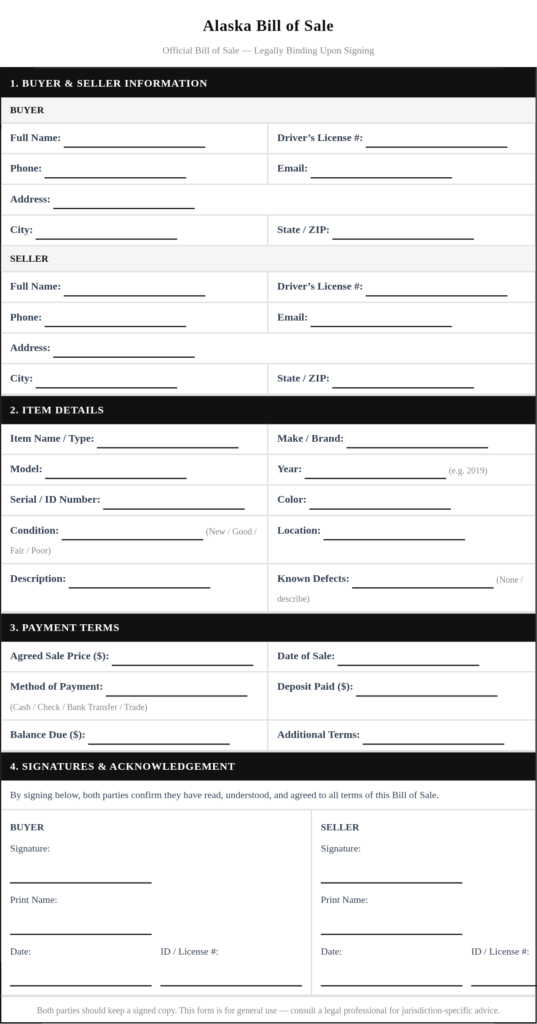
An Alaska Bill of Sale is a legal document that records the transfer of ownership for personal property between a buyer and a seller. You need this purchase record to prove you legally own the item, whether you bought a vehicle, boat, or other valuable property. The bill of sale form captures essential details like the sale price, item description, and signatures from both parties. This signed copy protects both the buyer and seller in a private sale by creating a legally binding agreement. Alaska law does not require bills of sale for all transactions, but having this purchase agreement helps prevent disputes and provides clear documentation of the property transfer.
Documents required in Alaska Bill of Sale
- Valid Government-Issued Photo ID
- Buyer and Seller Information
- Property Ownership Evidence
- Item Description Details
- Completed Bill of Sale Document
Information Included in a Alaska Sale Agreement
- Buyer's Name and Address
- Seller's Name and Address
- Detailed Property Description
- Agreed Sale Amount
- Transaction Date and Signatures.
How to Complete a Alaska Bill of Sale Form
- Identify the type of property you are selling and download the appropriate bill of sale form for vehicles, boats, or general personal property. Make sure the form meets Alaska sale requirements.
- Fill in the buyer and seller information including full legal names, addresses, and contact details. Write clearly to avoid confusion later.
- Describe the property in detail including make, model, year, serial number, VIN, or other identifying features. Include the sale price and payment method.
- Review all information with the other party to ensure accuracy. Both the buyer and seller should verify that all details match the actual transaction.
- Sign and date the document in the presence of each other. Each party should provide their printed name alongside their signature.
- Make copies of the completed sale agreement so both the buyer and seller have a signed copy for their records. Keep this purchase record in a safe place.
- Consider having the document notarized if the property requires registration or if either party wants extra legal protection for the transaction.
How to Notarize a AK Bill of Sale
- Understand that Alaska does not require notarization for most bills of sale, but a notarized document adds an extra layer of legal protection. Vehicles and certain high-value items benefit from notarization.
- Locate a notary public at your bank, credit union, shipping store, or through a mobile notary service. Many notaries charge a small fee for their services.
- Bring the completed but unsigned bill of sale form along with valid government-issued photo identification such as a driver's license or passport. The notary must verify your identity.
- Sign the document in front of the notary public. Do not sign beforehand, as the notary must witness the actual signing to validate the transaction.
- Wait for the notary to complete their certification by adding their official seal, signature, and commission information. This makes the document a legally binding notarized document.
- Receive your notarized copies and provide one to the other party. Keep your copy with other important records related to the property transfer.
FAQs
Q. Is a bill of sale legally valid in Alaska without notarization?
Yes, a bill of sale remains legally binding in Alaska without notarization as long as both parties sign it. The document creates a valid purchase record even without a notary seal. Notarization simply adds extra authentication and may help if you later need to prove the transfer of ownership in court.
Q. Does Alaska require a notarized bill of sale for vehicle sales?
Alaska does not legally require a notarized document for vehicle sales, but the Division of Motor Vehicles strongly recommends it. A notarized bill of sale helps prevent fraud and makes the title transfer process smoother. Many buyers and sellers choose notarization for expensive items like vehicles and boats.
Q. How many copies of the bill of sale should I keep?
Both the buyer and seller should keep at least one signed copy of the purchase agreement for their personal records. You may want to make additional copies if you need to submit one to the DMV or another agency. Keep your copy in a safe place with other important documents related to the sale.
Q. What information must an Alaska bill of sale include?
Your bill of sale form must include the full names and addresses of both buyer and seller, a detailed description of the personal property, and the sale price. You should also include the date of sale and signatures from both parties. For vehicles, include the VIN, make, model, year, and odometer reading to meet Alaska sale requirements.
Q. Can I use a handwritten bill of sale in Alaska?
Yes, Alaska accepts handwritten bills of sale as long as they include all required information and both parties sign the document. A handwritten sale agreement holds the same legal weight as a printed form. However, typed or printed forms often look more professional and reduce the chance of unclear handwriting causing problems later.
Conclusion
Completing an Alaska Bill of Sale gives you solid documentation for any private sale of personal property. This legal document protects both buyers and sellers by creating a clear record of the transaction, sale price, and property details. Whether you sell a car, boat, trailer, or other valuable items, having a signed copy prevents future disputes and proves ownership changed hands legally.
Alaska law does not mandate notarization for most transactions, but you can choose to have your purchase agreement notarized for added security. Keep your signed bill of sale form with other important records, especially if you need to register the property with a state agency. A properly completed sale agreement makes the entire property transfer process smoother and gives you peace of mind knowing you have a legally binding document that proves the transaction occurred.
Related Posts