![Free Printable Editable Bill of Sale Form Template [PDF, WORD]](https://billofsale.authorizationletter.org/wp-content/uploads/2026/06/billofsale_logo-206x48.png)
Documenting a sale in writing is a practical way to protect both the buyer and seller. A Kansas Bill of Sale provides evidence that a transaction took place and outlines important details such as the purchase price, date of sale, and property description. This form helps create a clear record of ownership transfer and may be useful when completing registration or other administrative requirements. Keeping accurate documentation can help prevent misunderstandings and support future ownership verification.
Download Free Printable Kansas Bill of Sale Template
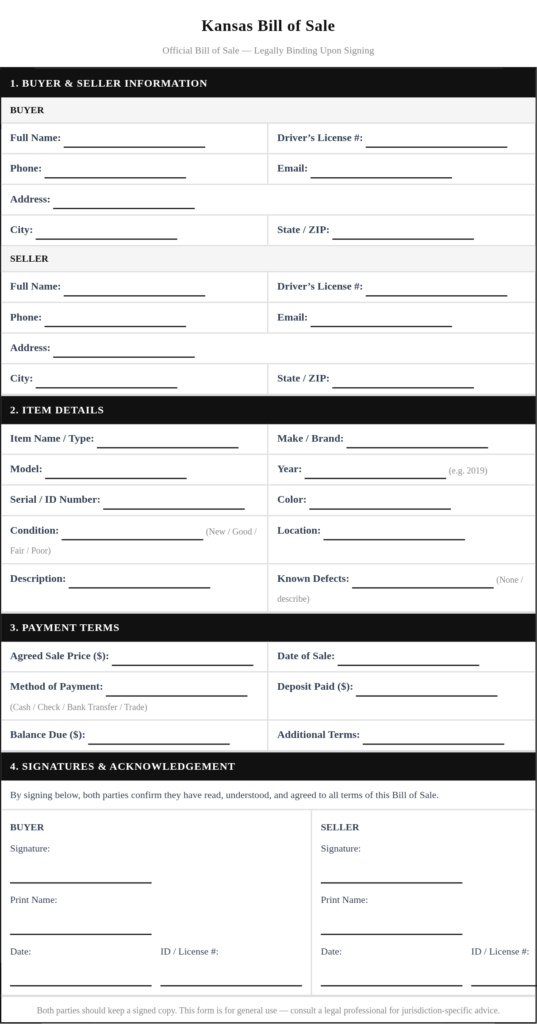 What Is a Kansas Bill of Sale?
A Kansas Bill of Sale is a legal document that records the transfer of ownership for personal property between a buyer and a seller. This purchase record serves as proof that a private sale took place and shows the sale price, item details, and the date of the transaction. Both parties receive a signed copy to protect their rights and confirm the purchase agreement. While not always required by law, this bill of sale form creates a legally binding record that helps resolve disputes and establishes clear ownership. Kansas residents use this property transfer document for vehicles, boats, firearms, livestock, and other valuable items.
Documents required in Kansas Bill of Sale
- Government-Issued Photo ID
- Buyer and Seller Contact Information
- Property Description
- Ownership Verification Documents
- Completed Bill of Sale Form
Information Included in a Kansas Sale Agreement
- Buyer's Name and Contact Information
- Seller's Name and Contact Information
- Description of the Item Sold
- Purchase Price
- Transaction Date and Signatures.
How to Complete a Kansas Bill of Sale Form
- Identify the item being sold and write a detailed description including make, model, serial number, VIN, or other identifying features. Include the condition and any defects to avoid disputes later.
- Enter the full legal names and current addresses of both the buyer and seller. Make sure all contact information is accurate and legible.
- Write the exact sale price in both numbers and words to prevent confusion or alterations. If the item is a gift, write 'gift' or '$0' as the purchase price.
- Add the date of sale and the location where the transaction takes place. This establishes when the transfer of ownership officially occurs.
- Include an 'as-is' clause if the seller offers no warranty or guarantees about the item's condition. This protects the seller from future claims.
- Review the entire bill of sale form with the other party to confirm all details are correct. Both the buyer and seller must sign and date the document.
- Make copies so both parties keep a signed copy for their records. Store the purchase record in a safe place with other important documents.
How to Notarize a KS Bill of Sale
- Understand that Kansas does not require notarization for most bills of sale, but a notarized document adds extra legal protection and credibility. Notarization becomes especially useful for high-value items or when registering certain property.
- Bring valid government-issued photo identification such as a driver's license or passport when visiting a notary public. Both the buyer and seller should appear in person with their IDs.
- Sign the bill of sale form in front of the notary, not beforehand. The notary must witness you signing to verify your identity and willingness to complete the sale agreement.
- Pay the notary fee, which typically ranges from five to fifteen dollars in Kansas. The notary will then stamp and sign the document to certify it.
- Request multiple notarized copies if you need them for registration, taxes, or personal records. Some institutions require original notarized documents rather than photocopies.
- Keep your notarized bill of sale with other important sale documents. This legally binding proof of the transaction may be needed for title transfers, tax filings, or insurance claims.
FAQs
Q. Is a bill of sale legally binding in Kansas without notarization?
Yes, a bill of sale becomes legally binding when both the buyer and seller sign it, even without a notary. Kansas law does not require notarization for most private sale transactions. The signed document serves as valid proof of the transfer of ownership and the purchase agreement between both parties.
Q. When should I get my Kansas bill of sale notarized?
You should consider notarization for high-value items like vehicles, boats, or real estate-related personal property. A notarized document provides stronger legal protection and makes the sale agreement harder to dispute. Some lenders or registration offices may also require a notarized bill of sale for certain transactions.
Q. How many copies of the bill of sale should I keep?
Both the buyer and seller should keep at least one signed copy of the bill of sale form for their records. You may need additional copies for vehicle registration, tax purposes, or insurance documentation. Store your purchase record with other important legal documents in a safe, accessible location.
Q. What information must a Kansas bill of sale include to be valid?
A valid bill of sale must identify the buyer and seller with full names and addresses, describe the item being sold, and state the sale price. The document must include the date of sale and signatures from both parties. Adding vehicle identification numbers, serial numbers, or detailed descriptions strengthens the legal document.
Q. Can a buyer return an item purchased with a Kansas bill of sale?
Kansas law does not automatically grant return rights for private sales between individuals. If the bill of sale includes an 'as-is' clause, the buyer accepts the item in its current condition with no warranty. The seller and buyer can negotiate return terms, but they must write these terms directly into the sale agreement to make them legally enforceable.
Conclusion
Creating a proper Kansas Bill of Sale protects both buyers and sellers during any private sale transaction. This simple legal document establishes a clear record of the property transfer, the agreed-upon sale price, and the condition of the item at the time of purchase. Whether you sell a car, boat, firearm, or other personal property, having a signed copy helps prevent misunderstandings and provides proof of ownership. Kansas residents should treat this purchase record as an essential part of any significant transaction.
You can find free bill of sale forms online or create your own document that includes all necessary details. Make sure both parties review the information carefully before signing. Store your signed bill of sale with other important documents, and consider getting a notarized document for expensive items or when extra legal protection matters. Taking these simple steps ensures your sale agreement stands up as a legally binding record that protects your rights and investment.