![Free Printable Editable Bill of Sale Form Template [PDF, WORD]](https://billofsale.authorizationletter.org/wp-content/uploads/2026/06/billofsale_logo-206x48.png)
A successful sale often depends on maintaining clear and accurate records. A Mississippi Bill of Sale provides written confirmation that ownership of property has been transferred and outlines the key details of the transaction. This document helps buyers and sellers establish proof of purchase while creating a reliable record for future reference. Having all information documented in one place can support registration requirements, clarify the terms of the agreement, and help protect both parties throughout the transaction process.
Download Free Printable Mississippi Bill of Sale Template
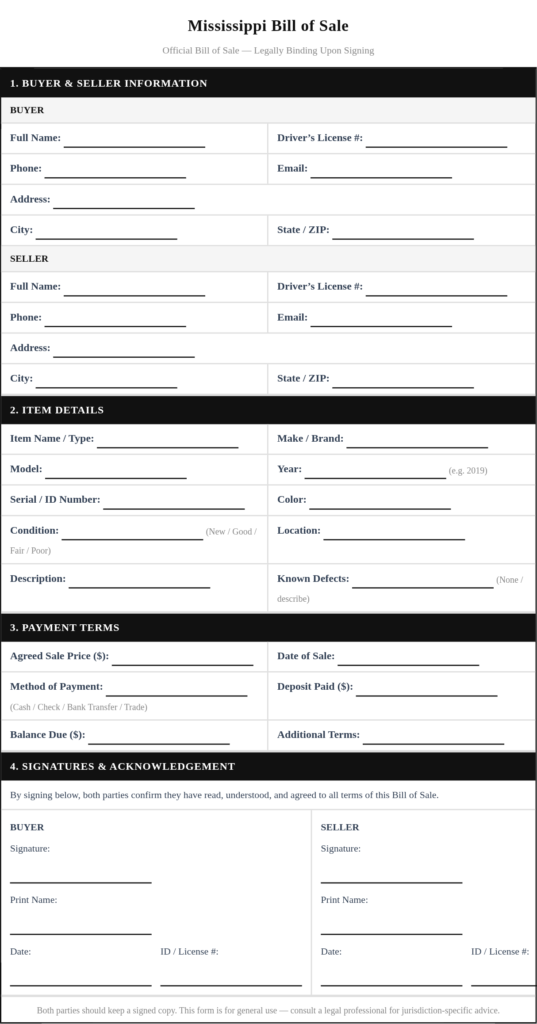 What Is a Mississippi Bill of Sale?
A Mississippi Bill of Sale is a legal document that records the transfer of ownership for personal property between a buyer and a seller. You need this purchase record to prove ownership, register vehicles with the state, and protect both parties in a private sale. The bill of sale form captures essential details like the sale price, item description, and signatures from both parties. This purchase agreement serves as legally binding proof that the property transfer occurred. Whether you sell a car, boat, or other personal property, a signed copy protects you from future disputes and provides a clear sale agreement for your records.
Documents required in Mississippi Bill of Sale
- Government-Issued Photo Identification
- Buyer and Seller Information
- Description of Property
- Supporting Ownership Documentation
- Completed Bill of Sale Document
Information Included in a Mississippi Sale Agreement
- Full Names of Buyer and Seller
- Contact Information of Both Parties
- Property Details
- Sale Price
- Date and Signatures.
How to Complete a Mississippi Bill of Sale Form
- Identify the type of property you are selling and download or create the appropriate Mississippi bill of sale form for that item.
- Fill in the seller's full legal name, address, and contact information clearly and accurately at the top of the document.
- Enter the buyer's complete name, address, and contact details in the designated buyer section.
- Describe the personal property in detail, including make, model, year, serial number, VIN, or any identifying features that make the item unique.
- Write the sale price in both numbers and words to avoid any confusion about the amount paid for the property transfer.
- Both the buyer and seller must sign and date the bill of sale form in the presence of each other to make it legally binding.
- Make copies of the completed purchase agreement so both the buyer and seller keep a signed copy for their records.
How to Notarize a MS Bill of Sale
- Check whether your specific transaction requires notarization under Mississippi bill of sale laws, as vehicles typically need notarization while other personal property may not.
- Bring the completed but unsigned bill of sale form, valid government-issued photo identification, and any supporting documents to a notary public.
- Sign the document in front of the notary while the other party also signs if both signatures require notarization.
- Allow the notary to verify your identity, witness the signatures, and complete the notarial certificate with their official seal and signature.
- Receive your notarized document and make copies so each party has a legally binding record of the sale.
- Keep the original notarized document in a safe place, as you may need it for vehicle registration or to prove ownership later.
FAQs
Q. Does a bill of sale prove legal ownership in Mississippi?
Yes, a bill of sale form serves as proof of the property transfer and purchase record between parties. The signed copy shows that the seller transferred ownership to the buyer on a specific date. However, for vehicles you must also complete title transfer with the state to establish full legal ownership.
Q. Do I need to notarize my Mississippi bill of sale?
Mississippi requires notarization for vehicle bills of sale to register the vehicle with the Department of Revenue. For other personal property, notarization is not mandatory but recommended. A notarized document adds an extra layer of legal protection and authenticity to your sale agreement.
Q. How many copies of the bill of sale should I keep?
Both the buyer and seller should keep a signed copy of the purchase agreement for their personal records. Make at least two copies of the notarized document if applicable. Keeping multiple copies protects both parties and provides proof of the sale price and terms if questions arise later.
Q. What information must a Mississippi bill of sale include?
Your bill of sale form must include the full names and addresses of the buyer and seller, a detailed description of the personal property, and the sale price. Both parties must sign and date the document to make it legally binding. For vehicles, include the VIN, make, model, year, and odometer reading.
Q. Can I use a Mississippi bill of sale for a private vehicle sale?
Yes, you can and should use a bill of sale for any private sale of a vehicle in Mississippi. This purchase record protects both the seller and buyer by documenting the sale agreement and transfer of ownership. You will need this legal document along with the title to register the vehicle with Mississippi sale requirements.
Conclusion
Creating a Mississippi Bill of Sale protects both parties in any transaction involving personal property. This legal document establishes a clear record of the sale price, item details, and transfer of ownership from seller to buyer. Whether you complete a private sale of a vehicle, boat, or other valuable items, having a signed copy prevents misunderstandings and provides proof of the purchase agreement. Mississippi bill of sale laws vary depending on the type of property, so understanding the requirements for your specific transaction helps ensure everything goes smoothly.
A properly executed bill of sale form gives you peace of mind and legal protection. The buyer receives proof of purchase and rightful ownership, while the seller has documentation that they no longer own the property. Keep your notarized document in a safe place along with other important records. Taking these simple steps creates a legally binding purchase record that protects your interests and satisfies Mississippi sale requirements for years to come.