![Free Printable Editable Bill of Sale Form Template [PDF, WORD]](https://billofsale.authorizationletter.org/wp-content/uploads/2026/06/billofsale_logo-206x48.png)
A written agreement is an important part of transferring ownership of valuable property. A New Jersey Bill of Sale helps document the terms of a transaction and provides proof that a buyer and seller have completed a sale. This form records key details about the property and the parties involved, making it easier to verify ownership in the future. Keeping accurate documentation can support administrative requirements, improve transparency, and provide added protection for everyone involved in the transaction.
Download Free Printable New Jersey Bill of Sale Template
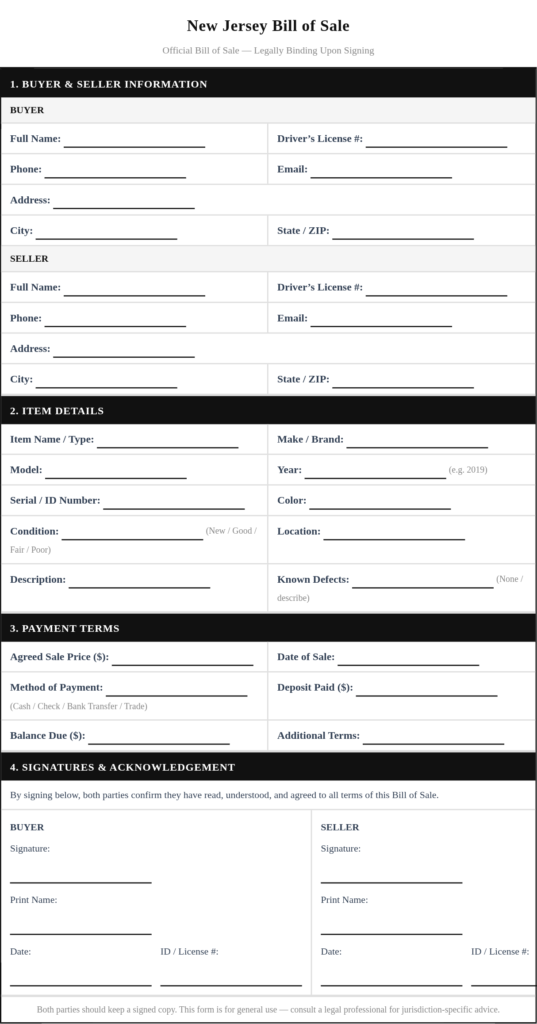 What Is a New Jersey Bill of Sale?
A New Jersey Bill of Sale is a legal document that records the transfer of ownership when personal property changes hands between a buyer and a seller. This purchase record creates a written trail of the sale and protects both parties by documenting the sale price, item description, and terms of the agreement. You need this signed copy whenever you sell or buy vehicles, boats, equipment, or other valuable items in a private sale. The bill of sale form serves as proof that the property transfer occurred and helps establish clear ownership rights.
Documents required in New Jersey Bill of Sale
- Government-Issued Photo ID
- Buyer and Seller Contact Details
- Property Information
- Supporting Ownership Documents
- Completed Bill of Sale Agreement
Information Included in a New Jersey Sale Agreement
- Buyer's Full Name and Address
- Seller's Full Name and Address
- Description of the Property
- Agreed Purchase Price
- Date of Sale and Signatures.
How to Complete a New Jersey Bill of Sale Form
- Write the date of the sale at the top of the bill of sale form. Include the full month, day, and year to establish when the transaction occurred.
- Enter the full legal names and current addresses of both the buyer and seller. Make sure all spelling is correct to avoid problems with registration or title transfers later.
- Describe the personal property being sold with specific details like make, model, year, serial number, VIN, or other identifying information. The more precise you are, the stronger your purchase record becomes.
- Record the exact sale price in both numbers and words to prevent any confusion. If the item is a gift, write zero dollars or indicate it as a gift.
- List any warranties, guarantees, or as-is conditions that apply to this sale agreement. Be clear about what the seller promises or disclaims regarding the item's condition.
- Have both parties sign and date the document in the presence of each other if possible. Each person should keep a signed copy for their records.
- Complete any additional state paperwork required for specific items like vehicles, which may need DMV forms alongside the bill of sale.
How to Notarize a NJ Bill of Sale
- Understand that New Jersey does not require notarization for most bills of sale, but a notarized document adds extra legal protection and authenticity. Some buyers or institutions may request it even when not mandatory.
- Contact a notary public if you choose to notarize your purchase agreement. You can find notaries at banks, law offices, shipping stores, or through mobile notary services.
- Bring valid government-issued photo identification such as a driver's license or passport when you meet the notary. Both the buyer and seller should appear with their IDs if both signatures need notarization.
- Sign the bill of sale in front of the notary rather than beforehand. The notary must witness you signing to make the notarized document legally valid.
- Pay the notary fee, which typically ranges from two to five dollars per signature in New Jersey. The notary will then stamp and sign the document to certify its authenticity.
- Make copies of the notarized bill of sale for your records before submitting it to any agency. Keep your copy in a safe place with other important transaction documents.
FAQs
Q. Does a New Jersey bill of sale need to be notarized to be legally binding?
New Jersey does not require notarization for a bill of sale to be legally binding in most cases. The signed agreement between buyer and seller creates a valid purchase record on its own. Notarization simply adds an extra layer of verification that can help if ownership disputes arise later.
Q. Can I use a handwritten bill of sale form in New Jersey?
Yes, you can use a handwritten bill of sale as long as it includes all essential information about the sale. Both parties must sign the document for it to serve as a valid legal document. Typed forms are often clearer and easier to read, but handwritten versions work just as well when complete.
Q. How many copies of the bill of sale should the buyer and seller keep?
Both the buyer and seller should keep at least one signed copy of the purchase agreement for their personal records. Make additional copies if you need to submit the bill of sale to the DMV, insurance company, or tax authority. Keeping multiple copies protects you if one gets lost or damaged.
Q. What information must appear on a New Jersey bill of sale to meet state requirements?
Your bill of sale should include the date of sale, full names and addresses of both parties, a detailed description of the property, and the sale price. For vehicles, add the VIN, make, model, year, and odometer reading. Both buyer and seller must sign the document to complete the transfer of ownership properly.
Q. Does a bill of sale replace a title when selling a vehicle in New Jersey?
No, a bill of sale does not replace the vehicle title in New Jersey. The seller must sign over the certificate of title to transfer ownership officially. The bill of sale serves as a supporting sale agreement and purchase record that documents the transaction details and protects both parties.
Conclusion
Creating a complete New Jersey Bill of Sale protects you whether you buy or sell personal property in a private transaction. This legal document establishes clear proof of the property transfer and records important details like the sale price and item condition. Both parties benefit from having a signed copy that shows exactly what changed hands and under what terms.
New Jersey bill of sale laws do not impose complicated requirements, which makes the process straightforward for buyers and sellers. You simply need accurate information, honest descriptions, and signatures from both parties to create a legally binding purchase agreement. Keep your bill of sale form with other important paperwork so you can reference it if questions arise about ownership, taxes, or registration. Taking a few minutes to complete this sale agreement properly saves you from potential headaches and disputes down the road.