![Free Printable Editable Bill of Sale Form Template [PDF, WORD]](https://billofsale.authorizationletter.org/wp-content/uploads/2026/06/billofsale_logo-206x48.png)
Buying or selling personal property involves more than just exchanging money. A properly prepared Alabama Bill of Sale helps create a clear record of the transaction and protects both parties by documenting important details such as ownership, purchase price, and the date of sale. Whether you are transferring a vehicle, equipment, or other valuable items, having a written agreement can help prevent misunderstandings in the future. This document also serves as useful proof of ownership and can support registration, tax, or legal requirements when needed.
Download Free Printable Alabama Bill of Sale Template
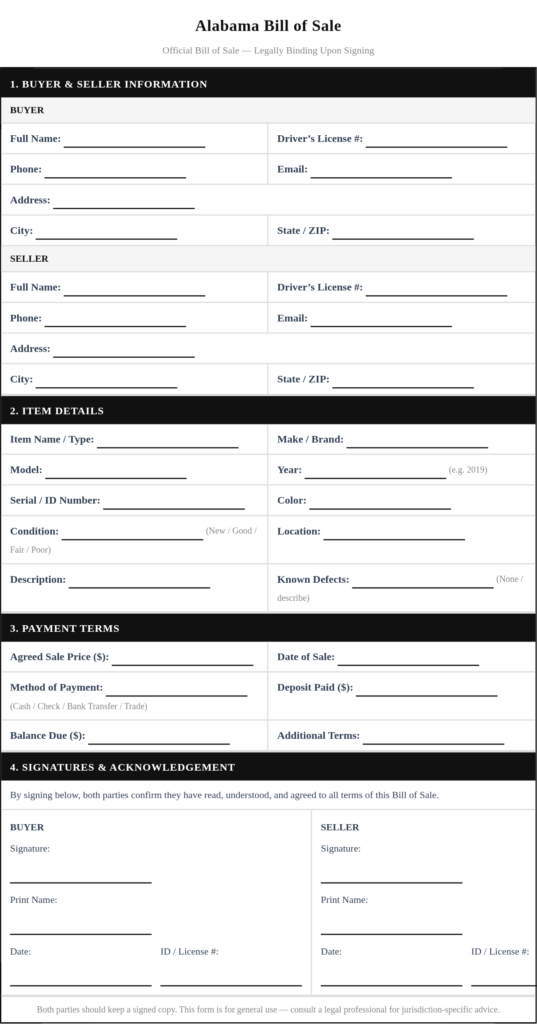
What Is a Alabama Bill of Sale?
An Alabama Bill of Sale is a legal document that records the transfer of ownership when a buyer purchases personal property from a seller. This written purchase record proves the sale took place and protects both parties in a private sale. The bill of sale form includes details like the sale price, description of the property, and signatures from both buyer and seller. Alabama law does not require a bill of sale for every transaction, but it serves as a vital purchase agreement that establishes a clear paper trail. You need one to register certain items like vehicles, boats, or firearms, and to prove ownership if any disputes arise later.
Documents required in Alabama Bill of Sale
- Valid Government-Issued Photo ID
- Buyer and Seller Contact Information
- Property Description
- Proof of Ownership (if available)
- Completed Bill of Sale Form
Information Included in a Alabama Sale Agreement
- Buyer's Full Name and Contact Information
- Seller's Full Name and Contact Information
- Description of the Property Being Sold
- Purchase Price and Payment Details
- Date of Sale and Signatures of Both Parties.
How to Complete a Alabama Bill of Sale Form
- Gather all necessary information about the buyer and seller, including full legal names, addresses, and contact details. You also need the exact sale price and the date of the transaction.
- Describe the property being sold in clear detail. Include make, model, year, serial numbers, VIN, or any identifying features that distinguish this item from others.
- Write the sale price in both numbers and words to prevent any confusion or alterations. State whether the buyer paid in cash, check, or another payment method.
- Include a statement that the seller legally owns the property and has the right to sell it. This protects the buyer from future ownership disputes.
- Both buyer and seller must sign and date the document in the presence of each other. Each party should print their name clearly beneath their signature.
- Make copies of the signed bill of sale form so both the buyer and seller keep a purchase record. Store these copies in a safe place with other important legal documents.
- Submit the bill of sale to the appropriate Alabama state agency if registering a vehicle, boat, or other titled property. The signed copy serves as proof of the property transfer.
How to Notarize a AL Bill of Sale
- Determine whether your specific transaction requires notarization in Alabama. The state does not mandate notarization for most bills of sale, but some buyers, sellers, or financial institutions prefer a notarized document for added legal protection.
- Locate a licensed notary public in Alabama if you decide to notarize. You can find notaries at banks, law offices, shipping centers, or through mobile notary services.
- Bring valid government-issued photo identification such as a driver's license or passport to the notary appointment. Both the buyer and seller should appear in person with their IDs if both signatures need notarization.
- Sign the Alabama bill of sale in the presence of the notary public. Do not sign the document beforehand, as the notary must witness you signing to make it legally binding.
- Pay the notary fee, which typically ranges from five to fifteen dollars in Alabama. The notary will then stamp and sign the document, creating an official notarized document.
- Keep the notarized bill of sale with your important records. A notarized sale agreement carries more weight if you ever need to prove the transaction in court or during a dispute.
FAQs
Q. Is a bill of sale legally binding in Alabama without notarization?
Yes, a bill of sale is legally binding in Alabama even without notarization as long as both parties sign it. The signed document serves as a valid purchase record and proof of the property transfer. Notarization adds an extra layer of authentication but is not required under Alabama bill of sale laws for most transactions.
Q. Does Alabama require a notarized bill of sale for vehicle sales?
Alabama does not require notarization for a vehicle bill of sale, but the document must be signed by both buyer and seller. The Alabama Department of Revenue accepts a standard bill of sale form as proof of purchase when you register the vehicle. Some lenders or buyers may request a notarized document for their own protection.
Q. Should both the buyer and seller keep a copy of the bill of sale?
Both parties should absolutely keep a signed copy of the sale agreement for their records. The buyer needs it to register the property and prove ownership, while the seller needs it to show they no longer own the item. Keep your copy in a safe place with other important legal documents in case questions arise later.
Q. What information must appear on an Alabama bill of sale to make it valid?
A valid Alabama bill of sale must include the names and addresses of both buyer and seller, a detailed description of the personal property, and the sale price. Both parties must sign and date the purchase agreement. Alabama sale requirements also recommend including the payment method and a statement that the seller owns the property free and clear.
Q. Can I use a handwritten bill of sale for a private sale in Alabama?
You can use a handwritten bill of sale in Alabama as long as it contains all required information and both parties sign it. A handwritten sale agreement is just as legally binding as a printed form. However, a typed or printed bill of sale form is clearer, easier to read, and less likely to cause confusion during the transfer of ownership process.
Conclusion
Creating a proper Alabama Bill of Sale protects everyone involved in a private sale transaction. This simple legal document establishes a clear record of the purchase agreement and proves the transfer of ownership occurred. Both the buyer and seller benefit from having a signed copy that shows the sale price, property description, and transaction date. Alabama law gives you flexibility in how you create this purchase record, whether handwritten or printed, notarized or not.
Take time to fill out your bill of sale form accurately and completely. Include all identifying details about the personal property being sold and make sure both parties understand the terms before signing. Store your signed sale agreement safely with other important documents. A well-prepared bill of sale gives you peace of mind and legal protection long after the transaction concludes.
Related Posts