![Free Printable Editable Bill of Sale Form Template [PDF, WORD]](https://billofsale.authorizationletter.org/wp-content/uploads/2026/06/billofsale_logo-206x48.png)
A written record can make any property transaction more organized and dependable. An Oregon Bill of Sale helps buyers and sellers document important details about a sale, including the property description, purchase price, and date of transfer. This document serves as proof that ownership has changed hands and can be useful for registration, record-keeping, or future reference. By maintaining a complete and accurate form, both parties can reduce the chance of disputes and create a reliable record of the transaction.
Download Free Printable Oregon Bill of Sale Template
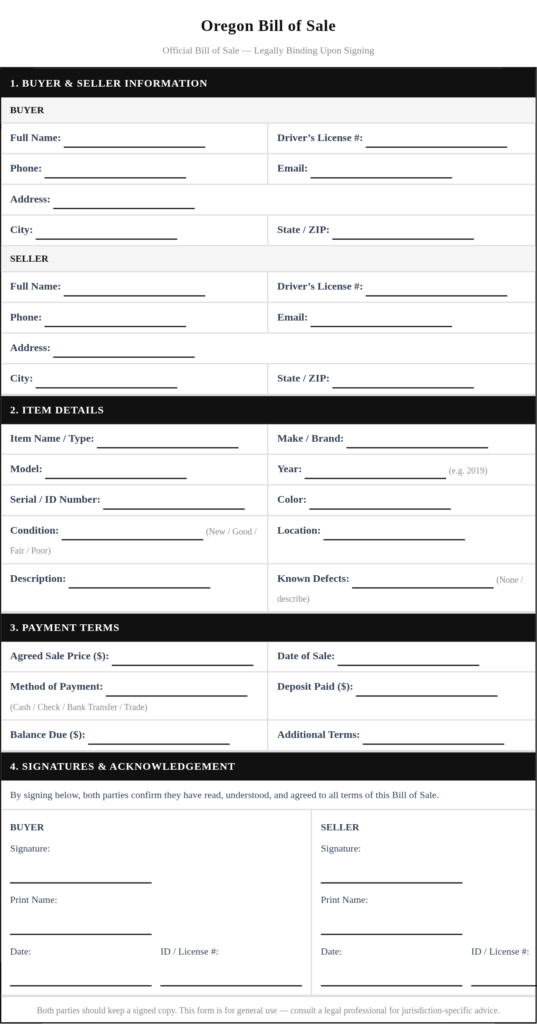 What Is a Oregon Bill of Sale?
An Oregon Bill of Sale is a legal document that records the transfer of ownership for personal property between a buyer and a seller. This purchase record serves as proof that a sale took place and details the sale price, item description, and the parties involved. While Oregon law does not require a bill of sale form for every transaction, having this signed copy protects both parties in a private sale. The document creates a legally binding purchase agreement that can help resolve disputes and provides essential documentation for registering certain items like vehicles or boats.
Documents required in Oregon Bill of Sale
- Government-Issued Photo Identification
- Buyer and Seller Contact Details
- Property Information
- Ownership Verification Documentation
- Signed Bill of Sale Form
Information Included in a Oregon Sale Agreement
- Buyer Information and Contact Details
- Seller Information and Contact Details
- Description of Property
- Sale Amount
- Date of Sale and Signatures.
How to Complete a Oregon Bill of Sale Form
- Identify the property being sold and write a detailed description including make, model, serial number, or other identifying features. Include the condition and any known defects to avoid future disputes.
- Record the full legal names and addresses of both the buyer and seller at the top of the bill of sale form. Make sure all contact information is current and accurate.
- Write the exact sale price in both numbers and words to prevent any confusion or alteration. If the item is a gift, write 'gift' or '$0' where the price appears.
- Include the date of the sale and the location where the transaction takes place. This establishes when the property transfer officially occurred.
- Add any warranties or statements about the condition of the property, such as 'sold as-is' if no guarantees are made. Be honest about what the seller promises.
- Have both the buyer and seller sign and date the document in the presence of each other if possible. Both parties should initial any corrections made to the form.
- Make copies of the completed sale agreement so both the buyer and seller keep a signed copy for their records. Store the document in a safe place for future reference.
How to Notarize a OR Bill of Sale
- Understand that Oregon does not require a bill of sale to be notarized for most personal property transactions. However, notarization adds an extra layer of legal protection and authenticity.
- Decide whether you want a notarized document for your transaction, especially for high-value items like boats, trailers, or expensive equipment. A notarized bill of sale can prevent fraud claims.
- Bring the completed but unsigned bill of sale form to a notary public if you choose notarization. Both the buyer and seller should appear in person with valid government-issued photo identification.
- Sign the document in front of the notary after showing your identification. The notary will verify your identity, witness your signature, and apply their official seal.
- Pay the notary fee, which typically ranges from five to twenty-five dollars in Oregon. Keep the notarized document in a safe place as your official purchase record.
- Remember that for vehicle sales in Oregon, the Department of Motor Vehicles handles the title transfer separately, and a notarized bill of sale is not required but can be helpful.
FAQs
Q. Is a bill of sale legally binding in Oregon?
Yes, a properly completed bill of sale form becomes a legally binding document once both parties sign it. The agreement provides proof of the sale and the terms both the buyer and seller agreed to. Courts recognize these sale agreements as valid evidence of the transfer of ownership.
Q. Does Oregon require a bill of sale to be notarized?
Oregon does not require notarization for most bills of sale involving personal property. Notarization is optional and adds credibility to the document. Many people choose to get a notarized document for expensive items or when they want extra legal protection.
Q. Should I keep a copy of my Oregon bill of sale?
Both the buyer and seller should keep a signed copy of the bill of sale for their personal records. This purchase record proves what you paid and when ownership transferred. Keep the document for tax purposes, warranty claims, or future sale of the property.
Q. What information must appear on an Oregon bill of sale?
A valid sale agreement must include the names and addresses of both parties, a description of the property, and the sale price. You should also include the date of sale and signatures from both the buyer and seller. Adding vehicle identification numbers or serial numbers helps identify the specific item being sold.
Q. Can I use a bill of sale instead of a title for a vehicle?
No, a bill of sale does not replace a vehicle title in Oregon. The Oregon DMV requires a properly signed title to complete the property transfer for cars, trucks, and motorcycles. Use the bill of sale as a purchase record alongside the title during a private sale.
Conclusion
Creating an Oregon Bill of Sale gives both parties peace of mind during any private sale of personal property. This simple legal document protects the buyer by confirming what they purchased and at what price, while it shields the seller from future liability once ownership transfers. Oregon law does not mandate this form for every transaction, but having a signed copy prevents misunderstandings and provides proof if questions arise later.
Whether you sell a car, a boat, furniture, or electronics, a clear purchase agreement benefits everyone involved. Take a few minutes to fill out the form completely, include accurate descriptions, and make sure both the buyer and seller sign before exchanging money and property. Keep your copy in a safe place with other important financial records. A well-prepared sale agreement turns a casual transaction into a documented, professional exchange that stands up in court if needed.